




You will not be allowed to compare more than 4 products at a time
Sunscreen & Sun Protection
-
Cetaphil Sunscreen SPF 30 | Dermat recommended for Sensitive Skin, 100ml
Regular price Rs. 1,089.00Sale price Rs. 1,089.00 Regular priceUnit price perRs. 1,313.0017% OFF -
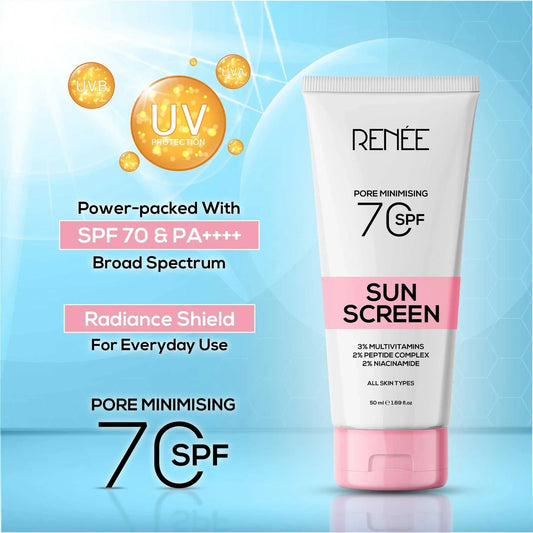
RENEE Pore Minimizing Sunscreen SPF 70 With 2% Niacinamide, 2% Peptide Complex & 3% Multivitamins, 50Ml
Regular price Rs. 299.00Sale price Rs. 299.00 Regular priceUnit price perRs. 325.008% OFF -
Minimalist SPF 50 Sunscreen
Regular price Rs. 379.00Sale price Rs. 379.00 Regular priceUnit price perRs. 399.005% OFF -
Foxtale Glow sunscreen SPF 50, In-Vivo Tested with PA++++
Regular price Rs. 291.00Sale price Rs. 291.00 Regular priceUnit price perRs. 297.002% OFF -
Foxtale SPF 70 Dewy Finish Sunscreen for Dry Skin
Regular price Rs. 495.00Sale price Rs. 495.00 Regular priceUnit price per -
Foxtale SPF 70 Matte Finish Sunscreen for Oily Skin
Regular price Rs. 495.00Sale price Rs. 495.00 Regular priceUnit price perRs. 495.00
Sunscreen and SPF Protection Online India: Shop Face Sunscreens for Oily, Dry and Sensitive Skin
Sunscreen is the single most impactful skincare product available. More than retinol, more than vitamin C, more than any serum at any price. In India, where the UV index exceeds 8 across most of the country for the majority of the year, UV-A radiation penetrates glass and cloud cover every day - causing collagen breakdown, photoaging, tanning, hyperpigmentation, and melasma year-round, regardless of whether you step outside. UV-B causes sunburn and direct DNA damage when it reaches the skin. One consistent daily SPF habit prevents more skin aging, dark spots, and uneven tone than any other single intervention and allows all other active serums you use to actually work without being counteracted by ongoing UV stimulus. At Zivanyaa, the sunscreen range covers Garnier, L'Oreal, Minimalist, and Foxtale formulas in gel, water-gel, and fluid textures - 100% authentic, free delivery above Rs. 499.
SPF and PA Ratings Explained
What the SPF Number Actually Means
SPF (Sun Protection Factor) measures UV-B protection only. SPF 30 blocks approximately 97% of UV-B rays. SPF 50 blocks approximately 98%. SPF 100 blocks approximately 99%. The percentage gap looks small but the dose difference is meaningful - SPF 30 allows 50% more UV-B to reach the skin than SPF 50 at the same application amount. For daily Indian conditions where most people underapply, SPF 50 provides a more practical real-world safety net. For outdoor activities and extended sun exposure, SPF 50 is the minimum. SPF 30 PA+++ is acceptable for low-exposure, fully indoor days.
What the PA Rating Means
The PA rating measures UV-A protection - the radiation responsible for tanning, collagen breakdown, photoaging, and hyperpigmentation. PA+ is minimal protection. PA++ is moderate. PA+++ is high. PA++++ is the maximum. UV-A penetrates glass and cloud cover at the same intensity year-round, which is why PA rating matters as much as SPF number for Indian skin. For anti-aging, pigmentation correction, or extended outdoor use in India, choose PA+++ or PA++++ regardless of the SPF number on the label.
Chemical vs Mineral Sunscreen: Which to Choose
Chemical Sunscreens
Chemical sunscreens use UV-absorbing filters - avobenzone, tinosorb S, tinosorb M, octinoxate, homosalate - that absorb UV radiation and release it as heat. They leave no white cast, making them the practical choice for Indian medium to deep skin tones. Allow 15 to 20 minutes after application before sun exposure or makeup - not because they need to "activate" but because the film needs time to dry down and form even coverage. Smearing or applying makeup too quickly redistributes the film and reduces protection. Most gel, water-gel, and fluid SPF formulas in India use chemical UV filters.
Mineral Sunscreens
Mineral sunscreens (zinc oxide, titanium dioxide) form a physical film on the skin that absorbs and scatters UV rays. They are effective immediately on application, make them the safest choice for sensitive, reactive, post-procedure, and acne-prone skin. The trade-off for Indian medium to deep skin tones is visible white cast - though tinted mineral formulas with iron oxides have significantly reduced this for deeper complexions.
Shop Sunscreen by Skin Type
Sunscreen for Oily Skin
Choose a matte-finish, oil-free, non-comedogenic gel or water-gel chemical sunscreen. These formulas absorb in seconds, leave no greasy film, and keep the base looking controlled through long days in Indian heat and humidity. The Garnier Super UV Cooling Watergel SPF 50 PA+++ is zero white cast, oil-free, and absorbs instantly - the most practical daily SPF for oily and combination Indian skin and the final step before makeup.
Sunscreen for Dry Skin
Choose a hydrating or satin-finish formula with glycerin, hyaluronic acid, or squalane. Pair with a moisturiser applied before SPF for a comfortable, dewy finish through the day. For complementary hydrating skincare to layer under your sunscreen, browse the dry skin range.
Sunscreen for Sensitive Skin
Choose fragrance-free, mineral-filter formulas or gentle chemical sunscreens without avobenzone, oxybenzone, or essential oils. Mineral formulas with zinc oxide are the safest for reactive, barrier-damaged, and rosacea-prone skin. For barrier-compatible skincare to layer underneath, browse the sensitive skin range.
How to Use Sunscreen Correctly
- Apply as the absolute final skincare step, after moisturiser has absorbed, before makeup
- Use at minimum half a teaspoon for the face and neck - most people apply far less than the amount tested in SPF lab conditions, which significantly reduces real-world protection
- Allow 15 to 20 minutes for the film to dry down before applying makeup or heading outdoors - this ensures even, undisturbed coverage
- Reapply every 2 hours outdoors, immediately after swimming, and after towel-drying
- SPF from foundation, compact powder, or BB cream does not provide adequate protection on its own - a dedicated sunscreen underneath is always required
- Apply on fully indoor days too: UV-A penetrates glass windows year-round and contributes to photoaging and dark spots even without direct sun exposure
Sunscreen Works Best Alongside These
Sunscreen is the final step that makes every other active work. For dark spot and pigmentation correction actives that pair with morning SPF, shop the pigmentation correction range. For anti-aging serums that need daily SPF to deliver results, see the anti-aging serum range. For non-comedogenic moisturisers safe to apply under SPF on acne-prone skin, browse the acne-safe skincare range.
Sunscreen FAQs
Is SPF 50 better than SPF 30 for Indian skin?
Yes, for most real-world use in India. SPF 50 blocks 98% of UV-B versus 97% for SPF 30 - a single percentage point that translates to 50% more UV-B reaching the skin at the same application amount. In practice, most people apply significantly less sunscreen than the lab-tested amount, which further erodes SPF 30's protection buffer. For outdoor exposure, driving, or anyone using active pigmentation correction treatments where every additional UV stimulus counteracts correction work, SPF 50 PA+++ is the better choice. SPF 30 PA+++ is adequate for low-sun indoor days.
Do I need sunscreen indoors in India?
Yes. UV-A radiation penetrates glass windows and cloud cover at the same intensity year-round. Sitting near a window at home or in an office provides ongoing UV-A exposure that causes collagen breakdown, photoaging, and hyperpigmentation every day - even with no direct sun exposure. Daily sunscreen on indoor days is the single highest-impact anti-aging and anti-pigmentation habit available. For anyone using brightening or pigmentation correction serums, skipping SPF even one day counteracts measurable progress.
Which sunscreen is best for oily skin in India?
A matte-finish, oil-free, non-comedogenic water-gel or fluid chemical sunscreen. The Garnier Super UV Cooling Watergel SPF 50 PA+++ is zero white cast, absorbs instantly without a greasy film, and does not pill under makeup - the most practical daily SPF for oily and combination Indian skin in India's heat and humidity. Avoid sunscreens with coconut oil, shea butter, or heavy emollient bases that contribute to midday shine and congestion.
Can I use sunscreen instead of moisturiser?
For oily skin in hot and humid Indian conditions, a hydrating SPF with glycerin or hyaluronic acid can replace the moisturiser step in the morning routine. For dry skin, a separate moisturiser applied before sunscreen provides the emollient and occlusive ingredients that most sunscreen formulas lack - particularly for dry skin in air-conditioned environments where additional lipid support is needed.
Does sunscreen cause acne or breakouts?
Comedogenic sunscreens with coconut oil, isopropyl myristate, lanolin, or heavy silicone emollients can cause or worsen acne. Non-comedogenic, oil-free gel and water-gel sunscreens are safe for acne-prone skin and should not trigger breakouts. If your current sunscreen is congesting the skin, switch to a lighter water-gel or fluid formula. Daily SPF is non-negotiable for acne-prone skin - UV worsens post-acne marks and PIH, which is already more pronounced on Indian skin.
Popular Searches
